
What Is an Edge AI Computer? Industrial Guide
What is an edge AI computer? Learn how industrial edge AI works, its benefits over cloud AI, and how to choose hardware for smart factories and machine vision.
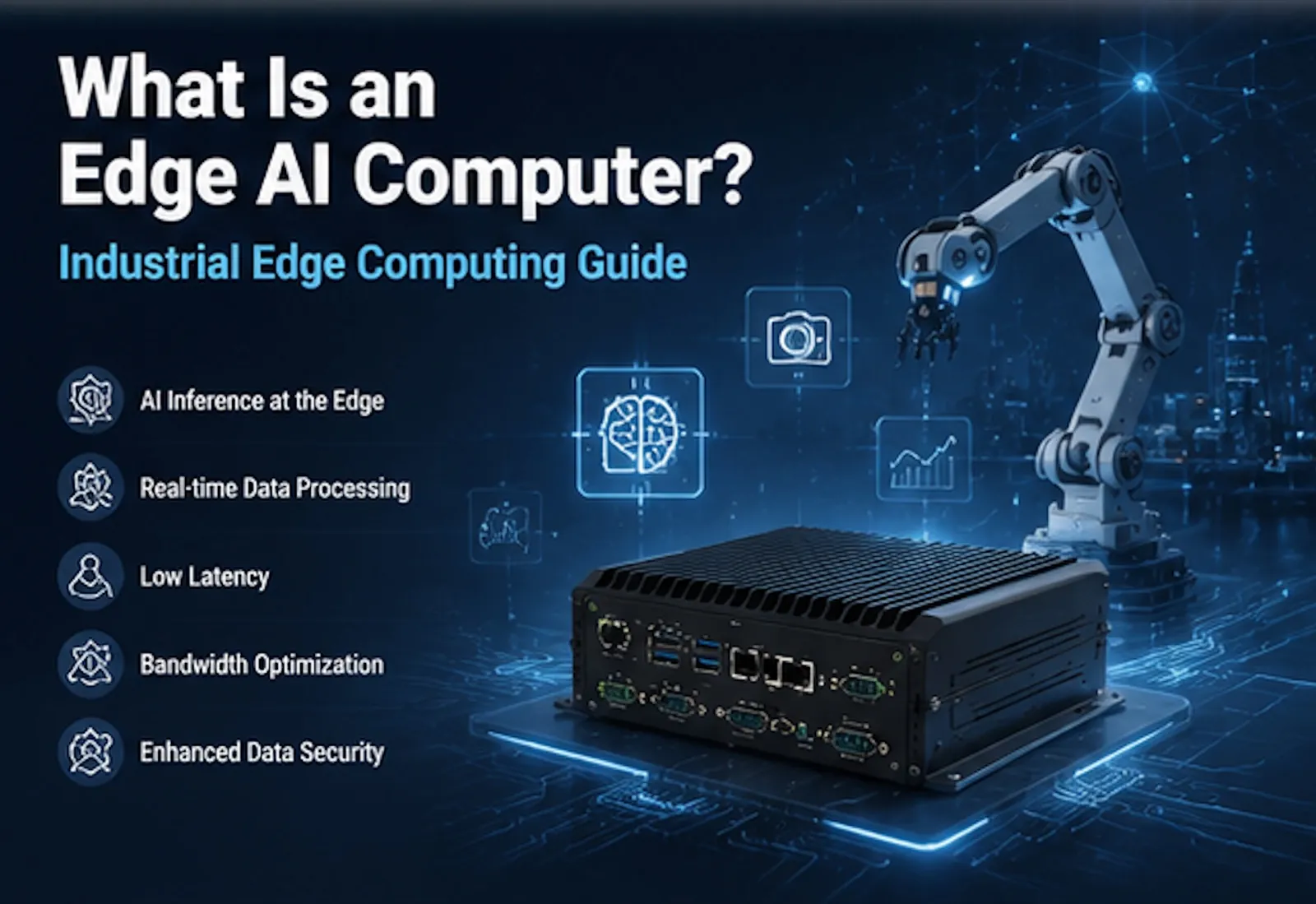
Artificial intelligence is transforming modern manufacturing. Factories are increasingly using AI for visual inspection, predictive maintenance, quality control and real-time decision-making.
But many engineers and factory managers face one critical question: should AI workloads run in the cloud or at the edge?
An edge AI computer answers this question by bringing AI computing directly to the factory floor, production line or industrial equipment where data is generated.
Unlike cloud AI systems that send data to remote servers for processing, edge AI computers execute AI inference locally — reducing latency, improving data privacy and enabling real-time industrial decisions.
Edge AI computers are widely used in:
- Smart manufacturing
- AI visual inspection
- Automated quality control
- Predictive maintenance
- Industrial robotics
- Machine vision systems
- Industrial IoT (IIoT)
IPCtech is an industrial PC manufacturer providing edge AI computers, AI industrial PCs, fanless industrial computers and customized edge computing solutions for global industrial applications.
What Is Edge AI Computing?
To understand an edge AI computer, it helps to first understand edge AI computing.
The traditional cloud computing model works like this:
- Sensors and machines generate data
- Data is sent over the internet to cloud servers
- AI models process the data on remote servers
- Results are sent back to the factory
This model works for some applications, but pure cloud AI has limitations for industrial use cases.
The edge AI computing model works differently:
- Sensors and machines generate data
- AI models run locally on an edge AI computer near the equipment
- Data is processed in real time without relying on the internet
- Only relevant results or summaries may be sent to the cloud
The key difference: computation happens close to the data source.
What Is an Edge AI Computer?
An edge AI computer, also called an AI industrial PC or AI edge computer, is an industrial computing platform designed to run AI inference workloads at the network edge.
AI Processing Capability
Edge AI computers include hardware acceleration for AI workloads:
- NVIDIA GPU modules (such as the Jetson series)
- Intel processors with integrated AI acceleration
- Neural processing units (NPUs)
- VPU and FPGA options
Industrial-Grade Reliability
Unlike consumer AI devices, edge AI industrial computers are designed for:
- 24/7 continuous operation
- Wide temperature environments
- Factory floor conditions
- Dust and vibration resistance
Local Data Processing
Edge AI computers process data directly at the source, providing:
- Real-time inference
- Low-latency responses
- Reduced network dependency
- Better data security
Industrial Interfaces
Edge AI systems connect to industrial equipment through:
- Gigabit Ethernet for cameras and sensors
- RS232 / RS485 for PLC communication
- GPIO for digital control
- USB 3.0 for high-speed cameras
Edge AI Computer vs Cloud AI: Core Differences
| Feature | Edge AI Computer | Cloud AI |
|---|---|---|
| Processing location | Local, at the machine | Remote data center |
| Latency | Millisecond level | Seconds or longer |
| Internet dependency | Not required | Required |
| Data privacy | Data stays on site | Data is transferred externally |
| Real-time capability | Designed for real time | Network dependent |
| Scalability | Per-device deployment | Centralized scaling |
| Typical use | Real-time inspection and control | Batch analysis and training |
Edge AI does not fully replace cloud computing. Many factories adopt a hybrid approach:
- Edge AI handles real-time inference and immediate decisions
- Cloud handles model training, long-term analysis and fleet management
Why Choose an Edge AI Computer for Industrial Applications?
1. Real-Time Decision Making
Industrial applications often require immediate responses.
For example, a vision system detecting defects on a fast production line must reject faulty products within milliseconds. A robotic arm needs real-time path adjustments based on camera input. Cloud AI cannot guarantee the response times these applications require. Edge AI computers provide deterministic, low-latency inference.
2. Reduced Network Dependency
Factory networks can suffer from:
- Bandwidth limitations
- Unstable connections
- Security restrictions
Edge AI computers operate independently of internet connectivity. Even when the network is unavailable, AI inference continues.
3. Better Data Privacy and Security
Many factories prefer to keep production data inside the facility. Edge AI computing ensures:
- Sensitive production data remains on site
- Proprietary process information is not transmitted externally
- Industrial data security policies are satisfied
4. Lower Bandwidth Costs
High-resolution industrial cameras and sensors generate enormous amounts of data. A machine vision system with multiple 5-megapixel cameras running at 30 frames per second can produce gigabytes of data per minute. Sending all of that to the cloud is expensive, slow and often impractical. Edge AI computers process data locally and send only relevant results.
5. Designed for Industrial Environments
Cloud servers run in controlled data centers. Edge AI industrial computers are designed for:
- Factory floors with dust and vibration
- Wide temperature ranges
- Continuous 24/7 operation
- Integration with industrial equipment
IPCtech edge AI computers use fanless designs, industrial-grade components and ruggedized enclosures for demanding manufacturing environments.
Core Components of an Edge AI Computer
AI Accelerator Hardware
The core of an edge AI system is its AI acceleration capability. Common hardware options include:
NVIDIA Jetson platforms — suitable for AI visual inspection, object detection, image classification and deep-learning inference.
Intel OpenVINO platforms — suitable for industrial automation, machine vision and edge analytics.
FPGA and NPU options — suitable for low-power applications, specific algorithm acceleration and customized AI pipelines.
Computing Performance Levels
Different industrial AI applications require different performance levels:
- Entry-level edge AI: simple quality checks, barcode reading and presence detection
- Mid-range edge AI: surface defect detection, object counting and assembly verification
- High-performance edge AI: multi-camera vision systems, high-speed line inspection and complex deep-learning models
AI Vision Computers: Key Applications
An AI vision computer is an edge AI system purpose-built for machine vision applications using AI.
Traditional machine vision relies on rule-based algorithms where engineers manually define what a defect looks like. AI vision computers use deep-learning models that can:
- Learn from sample images
- Detect complex and varying defects
- Adapt to product changes
- Improve continuously through additional training
Typical applications include:
- Surface defect detection
- Optical character recognition (OCR)
- Assembly verification
- Dimensional measurement
- Color detection
- Packaging verification
AI vision computers typically require GPU acceleration for deep learning, multiple GigE or USB camera connections, industrial communication interfaces and rugged mechanical design.
Edge AI in Smart Manufacturing
Automated Visual Inspection
Manual visual inspection is slow, inconsistent and labor intensive. AI-driven inspection systems can:
- Run 24/7 continuously
- Maintain consistent inspection standards
- Detect defects human inspectors may miss
- Record inspection results for traceability
Edge AI computers run vision AI models directly on the production line.
Predictive Maintenance
Unplanned machine downtime is extremely costly for factories. Edge AI computers enable predictive maintenance by:
- Monitoring equipment vibration
- Analyzing temperature patterns
- Detecting abnormal operating conditions
- Predicting failures before they happen
By processing sensor data locally, edge AI systems provide early warnings without relying on the cloud.
Industrial Robotics
Modern industrial robots increasingly use AI for:
- Vision-guided picking
- Autonomous navigation (AGV/AMR)
- Adaptive path planning
- Quality inspection during assembly
Edge AI computers provide the real-time computing power these applications need.
Process Optimization
AI can analyze production data to:
- Optimize machine parameters
- Reduce material waste
- Improve energy efficiency
- Increase production yield
Edge AI computers run optimization models close to production equipment for real-time adjustments.
Smart Warehousing
Warehouse applications include:
- Barcode and label reading
- Package dimensional measurement
- Automated sorting
- Inventory counting
Edge AI vision computers handle these tasks faster and more accurately than traditional methods.
How to Choose an Edge AI Computer
When selecting an AI industrial PC, consider the following factors.
1. AI Workload Requirements
Ask yourself:
- What type of AI model will run? (classification, detection, segmentation)
- What inference speed is required?
- How many camera streams must be processed?
- Will models be updated frequently?
2. Processing Hardware
Choose AI acceleration based on the workload:
- NVIDIA Jetson for deep-learning vision applications
- Intel processors with OpenVINO for general industrial AI
- FPGA/NPU for power-sensitive applications
3. Environmental Conditions
Consider:
- Operating temperature range
- Dust and moisture protection
- Vibration resistance
- Installation space constraints
For harsh factory environments, choose a fanless edge AI computer with industrial protection.
4. Industrial Interfaces
Verify the edge AI computer provides the required connectivity:
- Multiple network ports for cameras
- USB 3.0 for high-speed data
- RS232/RS485 for PLC communication
- GPIO for machine control
Why Choose IPCtech Edge AI Computers?
IPCtech combines AI acceleration hardware with industrial PC design expertise:
- Fanless and rugged enclosures for 24/7 factory operation
- Wide-temperature and anti-vibration design options
- Customizable I/O configurations for vision and control systems
- ODM/OEM support for application-specific AI platforms
- Factory-direct manufacturing with ISO 9001:2015 quality management
Contact IPCtech to discuss your edge AI computing requirements and request a tailored solution.