
What Is an Industrial PC? Buyer's Guide
What is an industrial PC? Compare industrial vs commercial computers, rugged features, and how to choose hardware for automation, machine vision, and edge AI.
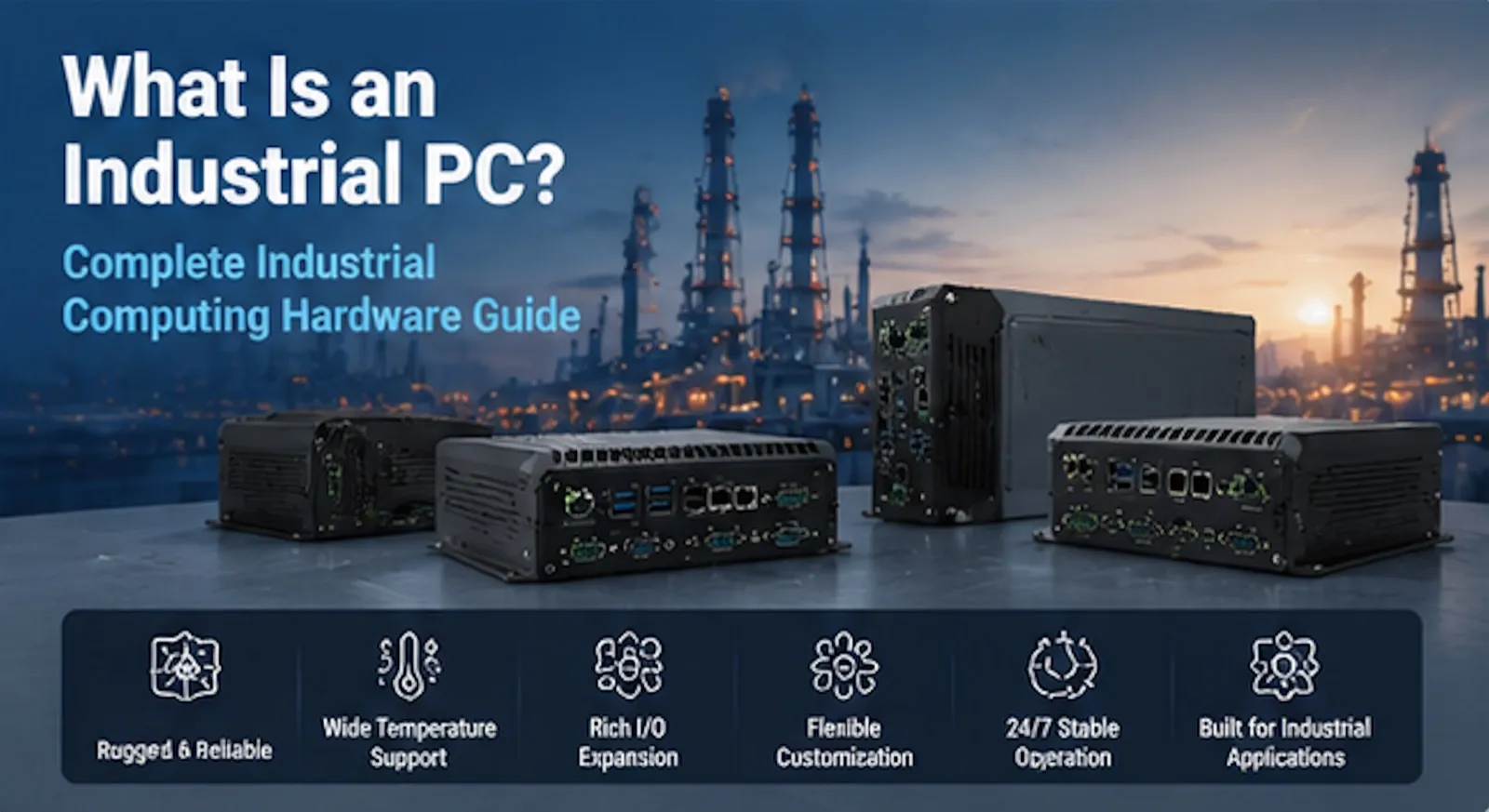
Meta Description: Learn the definition of an Industrial PC (IPC), core gaps separating industrial hardware from consumer commercial computers, key ruggedized functional characteristics, primary vertical deployment use cases and actionable hardware selection guidance for factory automation, manufacturing machine vision and edge computing industrial workloads.
What Is an Industrial PC (IPC)?
An Industrial PC, abbreviated IPC or Industrial Computer, represents a specialized category of computing hardware engineered exclusively for stable reliable operation within harsh industrial field environments where standard consumer commercial desktop hardware cannot sustain consistent long-term functionality.
In direct contrast to office-based consumer computers, industrial PCs prioritize four core design pillars for multi-year uninterrupted industrial deployment:
- Unmatched long-term operational hardware reliability & uptime stability
- Ruggedized mechanical construction to withstand hostile environmental conditions
- Native industrial communication peripheral I/O port integration
- Multi-year stable hardware component supply lifecycle support
Industrial PCs see mainstream deployment across core industrial verticals:
- Automated factory assembly line control systems
- Multi-camera machine vision quality inspection hardware
- Fully digitalized smart manufacturing production infrastructure
- Autonomous industrial robotics and AGV intralogistics fleets
- Cross-factory Industrial IoT (IIoT) sensor data aggregation gateways
- Low-latency edge real-time AI inference computing platforms
- Railway, new energy and transportation remote monitoring hardware
IPCtech is a professional industrial computing hardware manufacturer supplying fanless passive-cooled box PCs, compact embedded industrial controllers, touchscreen Panel PC HMI systems and fully customized edge computing hardware solutions for global industrial automation B2B clients.
Core Comparative Differences: Industrial PC vs Standard Consumer Commercial PC
Consumer commercial desktop hardware is engineered exclusively for clean climate-controlled office, education and residential indoor environments. Industrial PCs are purpose-built to operate reliably within dusty, oily, vibrating, temperature-fluctuating factory production floors and uncovered outdoor field hardware enclosures. Side-by-side core characteristic comparison table:
| Hardware Characteristic | Industrial PC (IPC) | Standard Consumer Commercial PC |
|---|---|---|
| Target Deployment Environment | Unregulated industrial factory & outdoor field sites | Climate-controlled clean office indoor spaces |
| Continuous Runtime Design Spec | Engineered for full 7×24 non-stop year-round operation | Limited to intermittent daily human office usage |
| Ambient Operating Temperature Window | Wide extended temperature range support | Narrow tightly restricted temperature band only |
| Electronic Component Grade | Rugged industrial-grade semiconductors & passive parts | Low-cost consumer-grade electronic components |
| Hardware Lifecycle Supply Window | 5–7 years stable fixed component supply guarantee | Rapid hardware iteration cycle, 1–2 year refresh cadence |
| Peripheral I/O Connectivity | Native industrial serial / CAN / GPIO / multi-LAN ports | Limited mainstream consumer USB & HDMI interfaces |
| Environmental Ruggedization | Full dust, water and vibration ingress protection options | No dedicated anti-dust, waterproof or anti-vibration reinforcement |
Industrial computing hardware prioritizes sustained operational reliability above raw peak processing performance for mission-critical production workflows.
Defining Core Functional Characteristics of Industrial PCs
1. Industrial-Grade Long-Term Operational Reliability
Nearly all industrial automation production workflows mandate continuous non-stop hardware operation spanning multiple consecutive years:
- Round-the-clock automated assembly production line control logic
- Uninterrupted visual quality inspection monitoring stations
- 24/7 railway track and renewable energy generation surveillance infrastructure
To deliver this consistent uptime performance, all industrial PC platforms integrate:
- Premium industrial-grade semiconductor electronic components
- Optimized balanced thermal dissipation chassis layout engineering
- Shock-resistant solid-state SSD storage media eliminating spinning hard drive failure risks
- Wide-tolerance stabilized industrial power regulation modules
2. Fanless Passive Cooling for Harsh Contaminated Environments
The majority of modern industrial PC hardware variants adopt fully fanless passive thermal dissipation architecture eliminating mechanical cooling fans entirely. Key operational advantages of fanless passive cooling design:
Drastically Reduced Hardware Maintenance Overhead
Cooling fans represent the single most common mechanical failure point in computing hardware; removing fans eliminates periodic fan cleaning, bearing replacement and unplanned downtime from fan malfunctions.
Superior Dust & Airborne Contaminant Resistance
Fan-cooled hardware pulls contaminated factory air through internal chassis via intake vents, depositing abrasive dust and oil mist on sensitive circuit boards over time. Fanless systems eliminate forced air intake entirely to minimize particulate buildup.
Fully Silent Zero-Noise Continuous Operation
Fanless hardware generates no audible mechanical hum, enabling deployment within noise-sensitive environments including medical diagnostic equipment integration, precision scientific laboratories and semiconductor cleanroom facilities.
IPCtech develops a full lineup of fanless passive-cooled industrial computing platforms optimized for continuous factory automation, edge AI and harsh field environment deployments.
3. Wide Extended Operating Temperature Compatibility
Industrial field deployments regularly expose computing hardware to extreme hot and cold ambient temperature swings from production equipment heat generation or uncovered outdoor installation locations. Industrial PC hardware integrates optimized thermal layout engineering and industrial-grade low-leakage electronic components enabling stable performance across wide temperature bands for use cases including:
- Uncovered outdoor traffic monitoring surveillance hardware
- On-board railway rolling stock control systems
- Remote wind and solar renewable energy generation monitoring stations
- Unconditioned factory workshop production line integration
4. Native Diverse Industrial Communication I/O Interfaces
A defining differentiator separating industrial PCs from consumer hardware is the full suite of specialized native industrial communication ports absent from standard commercial desktops:
RS232 / RS485 / RS422 Serial Communication Ports
Primary use cases:
- Bi-directional data exchange with PLC programmable logic controllers
- Analog industrial sensor and precision measurement instrumentation integration
- Legacy automated production machinery retrofitting connectivity
CAN Bus Fieldbus Interfaces
Primary use cases:
- Automotive vehicle on-board control networks
- Autonomous industrial robotic motion communication links
- Railway transportation rolling stock distributed control systems
GPIO General Digital Input/Output Terminals
Primary use cases:
- Direct digital actuation control of production machinery relays
- Real-time analog/digital sensor signal acquisition and processing
- Production line equipment safety interlock logic implementation
Multi-Port Gigabit Ethernet LAN Controllers
Industrial automation systems require multiple isolated network links for:
- Segmented secure industrial control network segmentation
- Simultaneous multi-machine real-time production data aggregation
- Isolated machine vision camera dedicated data transmission lanes
5. Multi-Year Stable Hardware Lifecycle Supply Support
Full industrial factory automation infrastructure deployments remain operational for 5–10+ continuous years. Frequent mandatory hardware refresh cycles introduce severe operational risks:
- Critical legacy industrial automation software compatibility breakdowns
- Costly unplanned production downtime during full hardware replacement cycles
- Repeated redundant system integration and recertification engineering labor overhead
Reputable industrial PC manufacturers deliver formal multi-year lifecycle support commitments including:
- Unchanging fixed hardware platform component supply for 5–7 years minimum
- Full bespoke hardware ODM customization services for project-specific unique I/O and mechanical requirements
- Long-term legacy spare parts stocking guarantees post hardware EOL discontinuation
Primary Vertical Application Workloads for Industrial PCs
Factory Automation Control
Industrial PCs act as the core central compute platform for all automated manufacturing workflows:
- Standalone production machinery motion control logic execution
- Real-time cross-line production performance data monitoring & visualization
- Multi-site industrial IoT sensor data aggregation gateway routing hardware Primary integration use cases: PLC controller interconnection, closed-loop process control, centralized production status dashboards
Machine Vision Quality Inspection
Machine vision automated inspection systems impose strict hardware performance prerequisites:
- Sustained consistent high-throughput image processing capability
- Simultaneous multi-industrial-camera high-bandwidth data capture
- Hard low-latency real-time image analysis and automated decision-making logic
Industrial PC hardware powers full end-to-end visual inspection workflows including:
- Automated surface defect detection & classification
- Precision dimensional measurement quality verification
- Assembly line component presence/absence sorting automation
Edge AI Real-Time Computing
Modern digital smart manufacturing facilities shift heavy machine learning and image analysis workloads to local on-site edge computing hardware to eliminate latency introduced by remote cloud-based processing. Edge industrial PC hardware enables localized offline data processing delivering:
- Minimized end-to-end autonomous production adjustment decision latency
- Fully offline